A few weeks back I heard from an old flame on social media. He’s in the States and I don’t hear from him often, but we keep an eye on how each other are doing. He recently published a photo of himself from back in the day when we knew each other and I challenged him to post a photo of how he looks now—more than twenty years later. He sent me a photo by DM without posting it. He looked good, and I told him so. His response was, Yeah, I look fine for my age! It got me thinking about what that means.
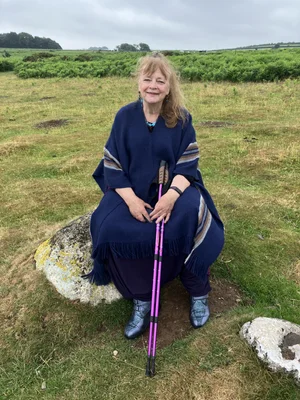
If I’m honest, back when I was approaching 50 and people found it hard to believe, I was really pleased when people told me that I looked several years younger. As soon as grey hairs started appearing I got my hairdresser to colour them out. This all changed once I reached 70 and realised what I’d been doing—instead of owning my age, I was trying to camouflage it.
Rise in the use of plastic surgery
Around the time I was in contact with my American friend, I also came across an article about young women wanting facelifts and I found it shocking. In the UK The British Association of Aesthetic Plastic Surgeons has reported an 8% increase in facelifts. It seems that the widespread use of weight-loss drugs, plus the possibilities of pursuing cut-price medical procedures abroad encourage people to have work done. Added to that is the fashion for using dermal fillers without knowledge of how they can stretch the face and cause skin-laxity—meaning people seek plastic surgery to correct the damage caused by earlier procedures.
Of course, social media has also contributed to the normalisation of cosmetic surgery. Online influencers regularly get offered procedures for free and then praise them to their followers—often while minimising the very real risks involved. Sharing details of their ‘tweakments’ and promoting their effects helps to make procedures like Botox and Filler seem accessible and perhaps even advisable.
In our apparently never-ending quest to remake our physical bodies in whichever image we think will set us on the correct course in our lives, an increasing number of women and men are turning to cosmetic surgery as a way to improve their lives. The quest is not even necessarily to appear younger but to look our ‘best selves.’ While few would dispute the miraculous power of plastic surgery to repair faces and bodies that have suffered injury or accident, there could be deeper issues to explore for women between 25 and 45 spending a great deal of money to invest in altering their appearances simply because the possibility is available. I found myself wondering how many surgeons take the time to delve into a prospective patient’s mental state before agreeing to proceed.
Ageing online
I’m only beginning to get an informed idea of the pressure young women experience in this increasingly digital era. Although familiar with manoeuvring my way around social media, I don’t subscribe to all platforms and only pursue my own specific interests. Tik Tok is not a platform that I use but I see that it is fantastically popular among younger people and so I had a look. It provides an easy way for people to influence trends and assert ‘standards. For example, in 2024, it launched a new trend that showed women posing for the camera and asking, ‘How old do I look?’ I just watched some and it shows women feeling vulnerable about how they look and people’s responses predictably telling them they look a lot older than they are—and meaning that as an insult.
Then there is the Instagram face. In a 2024 observational study published in Aesthetic Surgery Journal Open Forum, researchers describe this face as ‘symmetrical, matching the golden ratios, with a small and neat nose, full and lush lips, high cheekbones, as also a sharp and chiselled jawline.’ When you consider around 95 million photos are uploaded to Instagram every day, are often digitally manipulated, you wonder about the impact of this unattainable ideal on the possibly fragile confidence of young women. Even if women realise the extent to which these images have been doctored, it can still make them feel that they are not good enough. With advice and suggestions readily available to them on their favourite platforms, it’s all too easy to start shopping around for procedures that will help them to feel better. Of course, they rarely do as feeling bad about oneself is not so easily ‘fixed.’ Then it’s a small step to try another procedure and so on.
Sadly, one way to make yourself feel better can be to project on someone else the very worry, or fear that is besetting you. So, you see people age shaming other women, celebrities, politicians—anyone in the public eye. Torn between insisting women age gracefully, and resentment when they go their own way, society seems to be engaged in a refusal to leave women alone to age in their own way, at their own pace.
As women we internalise society’s resistance to ageing
We’re all aware of the onslaught of the cosmetics industry on our ageing journey and its insistence that we age in the way they proscribe. What we don’t always realise is the extent to which we have internalised their aversion. Both regarding our own ageing process, and the way we view others, it’s very easy to slip into the opinion that ageing is something to regret and even feel shame for. Add to that the fact that the Boomer generation is living longer than their parents and the increasing political story of the costs that imposes on society and we could even add guilt to the mix.
I feel it's time to look inwards and discover our own path towards old age. It has rocky periods and plenty of challenges but it’s our own, individual journey and an opportunity to reap the benefits of our experience, our stories. We need to deconstruct our internalised perception of ourselves as ‘less’ because we have more years. It can be a time of growth, and deepening knowledge—an opportunity to come to know ourselves better and rejoice that we have lived this far. What a shame to waste it while trying to deny our age and the changes in how we appear. Every line, every wrinkle is a story of our lives and a cause for celebration.
Do you have any thoughts about age-shaming? If so I would be very interested to hear them…..so do comment and share.